
Grover® Tuners – “World’s Finest Machine Heads”
For over a century, Grover® has been trusted by musicians and manufacturers around the world for precision, reliability, and lasting performance. Our tuners have become an integral component on many of the industry’s most iconic instruments and remain a top choice for aftermarket replacements. Explore our complete lineup of standard and locking tuners, along with a variety of gear ratios and button options, to find the perfect fit for new builds, upgrades, restorations, or customizing your instrument.
Why Grover®?
- Replace worn, damaged, or low-quality tuners.
- Improve tuning stability and accuracy.
- Benefit from higher gear ratios for more precise tuning adjustments.
- Upgrade to locking tuners for faster, easier string changes.
- Reduce headstock weight and improve instrument balance.
- Customize the look of your instrument with a variety of finishes and button styles.
Which Grover® tuners will fit my instrument?
- Replacing Existing Grover® Tuners
Visit our website at www.grotro.com to identify your current Grover® tuners. Each tuner series page includes detailed specifications and schematic drawing.
Once you have identified the tuner model, review that product page to determine whether compatible drop-in replacement options are available.
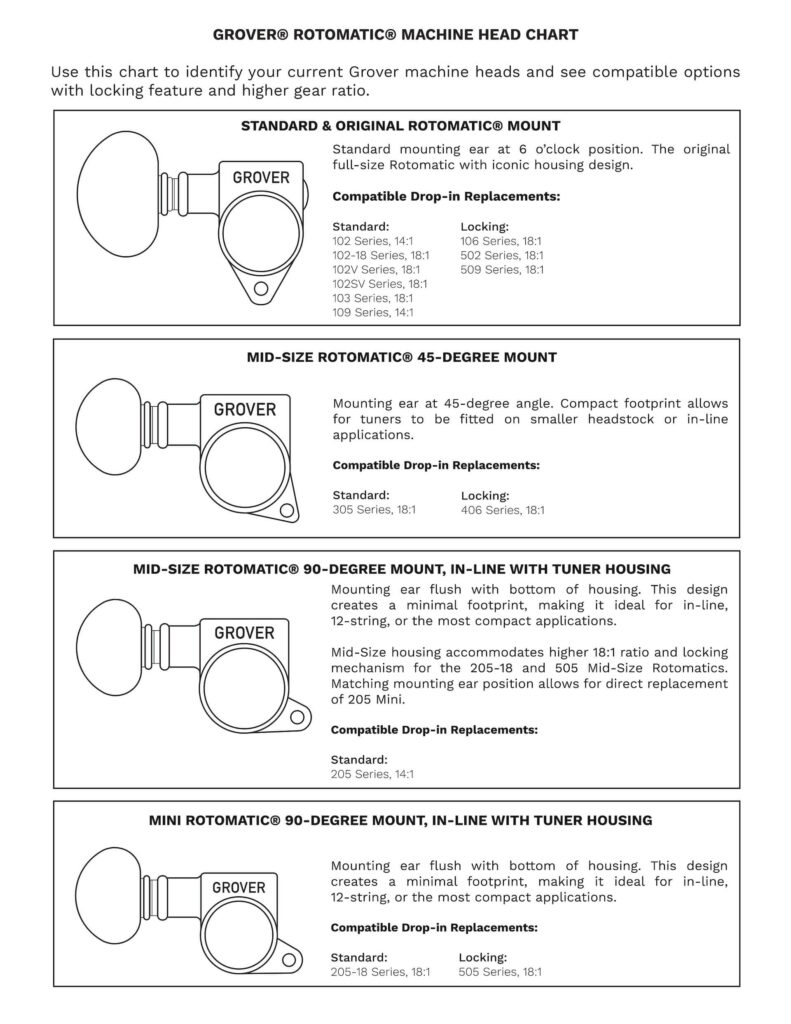
Many Grover® Rotomatic® models offer direct replacement options that require no modification to the instrument. All Rotomatic® tuners fit a standard 10 mm post hole; the primary difference between models is the location of the mounting screw ear, which is available in three positions.
Rotomatic® Compatibility Chart
Need help identifying your tuners?
Email clear photos of both the front and back of your headstock to [email protected]. Our team can help identify the closest Grover® model, though final fitment should always be verified by comparing specifications and schematics.
- Replacing Non-Grover® Tuners
Our website includes detailed specifications and schematic drawings for every Grover® tuner model. When comparing replacement options, verify:
- Overall tuner dimensions
- Post hole size
- Mounting screw locations
- Tuner alignment and orientation
Because tuner fitment varies greatly between instruments, we recommend consulting a qualified technician or luthier before modifying your instrument.
Does Grover® Offer Custom Sets?
All Grover® tuners are available in custom configurations, such as for 7-string guitar, 5-string bass, etc. Visit Sweetwater at www.sweetwater.com for pricing and to arrange a special order.
I am looking for a tuner in a specific finish but cannot seem to find it listed. Where can I find these special finishes?
Most Grover® tuners are available in:
- Chrome (C)
- Nickel (N)
- Gold (G)
- Black Chrome (BC)
Occasionally, special finishes are produced exclusively for OEM instrument manufacturers. These finishes are generally not available through aftermarket sales channels.
Where can I purchase Grover® tuners? Can I buy directly from Grover®?
Grover® is a manufacturer and does not sell directly to consumers. We recommend working with one of our authorized dealers, which can be found here: Grover Dealers
I am missing a tuner or part; can I purchase one directly from you?
Please visit our Grover® “Warranty” page for more information and further assistance, which can be found here: Grover Warranty
I am looking for replacement button washers for my Grover® tuners. Are these covered under warranty?
Please note that metal washers, nylon washers, and spring washers are considered wear-and-tear items and are not covered under the Grover® Lifetime Warranty.
Replacement washers can be purchased through any authorized Grover® dealer. A list of authorized dealers can be found here: Grover Dealers
For example, the GPB18 Replacement Washer Set for Rotomatic® Tuners: GPB18 Replacement Washers for Rotomatic® Tuners
My instrument won’t stay in tune, and I think the tuners may be the problem (Why it’s not your tuners).
Set Up Issues
Your instrument’s overall setup plays a huge part in its sound, playability, and tuning stability. If your instrument isn’t staying in tune, we always recommend consulting a local repair shop or luthier to ensure a proper setup. Some other factors to check for are below.
Nut
The nut slots might be cut too narrow or shallow for your string gauge, causing pinching of the string, which may cause problems while tuning. You can alleviate this by using a file to address the grooves or using a form of lubrication.
Stretching the Strings
One of the most common tuning issues that many musicians run into is improperly stretched strings. New strings require time to break in before they achieve the ability to hold the desired tension, seat properly in the nut, tuners, and the ball end.
“G” String
On headstocks with a 3 x 3 tuner arrangement or – The 3rd and 4th strings end up breaking at a hard angle at the nut. This angle puts a strain on these two strings and can result in tuning issues.
Truss Rod
Many stringed instruments have a truss rod to support the neck. To identify if your truss rod needs adjustment, lay your instrument on a flat surface, observe if the neck is either bending away from the strings, towards the strings or is straight. Locate the truss rod adjustment nut. To tighten the truss rod, turn to the right, to loosen, turn to the left.
Intonation
Begin with a properly adjusted Truss Rod. If the instrument’s intonation is sharp, move the saddle away from the fretboard, increasing the string length and lowering the pitch. If the intonation is flat, move the saddle closer to the fretboard, tightening the strings and raising the pitch.
Tremolo
When using a Tremolo strings gain slack and become loose and out of tune due to the stretching of the string.
Climate
Instruments and their strings are affected by changes in temperature as they will expand when warm and contract when cold causing the instrument to go out of tune.
Player’s Touch Matters
Heavy handed playing can pull the chords and notes out of tune. Make sure you are not using too much force, especially when playing larger frets.
*Please note, we always recommend consulting a repair shop or authorized luthier whenever installing hardware or making any modifications to your instrument.
Grover® Tuner Lifetime Warranty
Our warranty covers failure as a result of a manufacturing defect on Grover® Tuners. It does not cover normal wear and tear, including washers, tarnishing or wear-through of plating, or damage not because of normal use. See full warranty and online form here: Grover Warranty
I have contacted you regarding a warranty claim but have not received a response.
We do our best to respond to all inquiries promptly and personally. We do not utilize AI-generated customer support responses—every inquiry is reviewed and answered by a member of our team.
If you have not received a response within 72 hours, please contact us at [email protected] and include a copy of your original request so we can investigate and assist you further.